

I’ve run real websites on both Namecheap and Verpex, not just test environments, but actual sites with real traffic. That means the performance numbers, the support stories, and the quiet wins you’ll read about here come from direct experience, not a spec sheet.
So why compare Verpex vs Namecheap specifically? Because they attract the same kind of customer. Someone who wants reliable hosting without enterprise-level pricing, yet they take very different approaches to delivering it.
Namecheap is a household name in the domain and hosting world, having built its reputation over two decades on affordable pricing and sheer brand recognition. Verpex is the newer challenger, a company that’s made speed, support, and global infrastructure its core identity.
Both are legitimate choices. But they’re not equally good for every situation, and the differences that matter most aren’t always the ones listed on their pricing pages, or even the ones a quick CDN-cached speed test suggests.
By the end of this article, you’ll know exactly which host fits your needs. Whether you’re launching your first WordPress site, scaling a WooCommerce store, managing client sites as an agency, or just looking for the most reliable host for your money in 2026.
Namecheap vs Verpex: Quick Verdict
Before we go deep, here’s the short version for those in a hurry:
Namecheap’s origin server held up more consistently in our real-world testing than Verpex’s, with no swap pressure or disk crowding, and it becomes genuinely fast once you pair it with Cloudflare’s cache rules and Smart Tiered Cache.
Verpex still brings real, unrelated advantages to the table: NVMe storage on paper, Redis on shared hosting, WP Toolkit, unlimited email on every plan, and a wider spread of datacenters. But when we checked what was actually happening on the server behind those tools, we found swap usage as high as 98% and disk utilization above 85%.
The rest of this article explains exactly why, with the data to back it up.
Namecheap & Verpex: Company Overview
Namecheap
Founded in 2000, Namecheap started as a domain registrar and has grown into a full hosting provider. Today, it’s one of the most recognizable names in the industry, managing over 24 million domains and hosting millions of websites worldwide.
Its strength has always been price. Namecheap consistently undercuts the market on domain registration and entry-level hosting plans. What surprised us in testing is that the value doesn’t stop at price. The origin server itself performed steadily, without the resource strain we found elsewhere.
Verpex
Verpex launched in 2019, which makes it a relative newcomer. But in the hosting world, being new isn’t a weakness. It means the entire platform was built on modern infrastructure from day one, without the technical debt that older web hosts carry.
Verpex has rapidly built a strong reputation on Trustpilot and other hosting review platforms, particularly for its customer support. It’s grown by targeting users who feel underserved by the big names. Its shared hosting resource limits, however, showed real strain when we looked past the marketing numbers.
Hosting Plans & Pricing
Namecheap Shared Hosting Plans
Namecheap’s shared hosting lineup is built around three tiers: Stellar, Stellar Plus, and Stellar Business.
The Stellar plan is the entry-level option, starting at just $1.78/month for the first year after the initial 30-day free trial. It lets you host up to three websites with 20GB of SSD storage, unmetered bandwidth, and 30 email accounts.
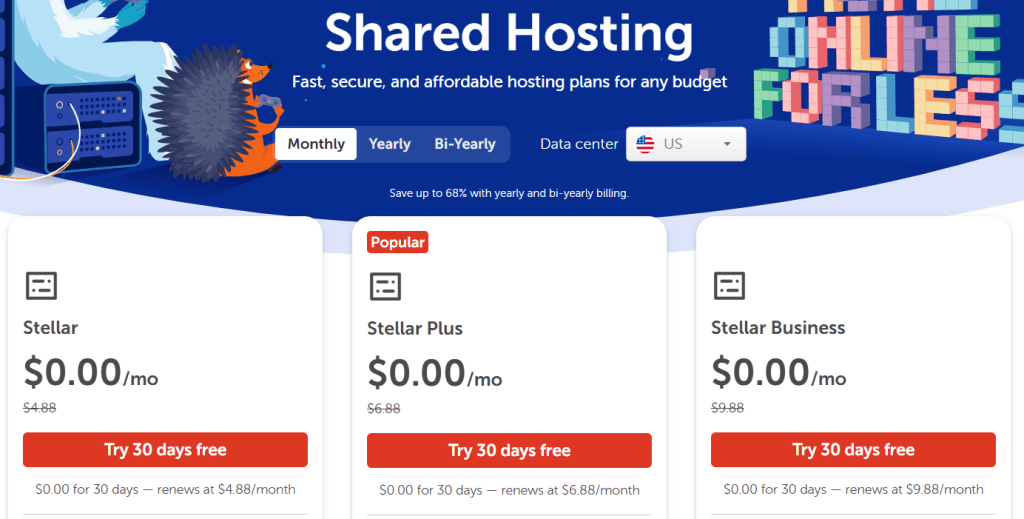
That email cap is worth paying attention to. If you’re running a business with multiple staff or departments, 30 accounts fill up faster than you’d expect. You’d need to upgrade to Stellar Plus or Stellar Business just to get unlimited email, a limit which Verpex doesn’t impose on any of its plans.
Stellar Plus removes those constraints, offering unlimited websites, unmetered SSD storage, and AutoBackup.
This is the plan most users will gravitate toward, and it costs $33.36 in the first year ($2.78/mo), but you renew at $74.88. It strikes the best balance between price and flexibility for small to medium-sized sites.
The Stellar Business plan is the premium option, starting at $3.98/mo or $47.76 for the first year. It adds 50GB of SSD storage alongside Cloud Storage for improved reliability and is tailored for businesses managing multiple high-traffic websites.
One thing Namecheap deserves credit for is transparency on pricing improvements. Renewal prices under the new Stellar lineup reflect roughly 60% savings compared to the previous plans.
However, Namecheap does not offer a money-back guarantee, since it already offers a 30-day free trial. And that makes sense from user point of view.
You can test any of the Stellar hosting plans for 30 days without paying anything. That’s better than requesting a refund if things don’t go as expected.
That said, the introductory discount still drops off sharply at renewal. Signing up for Stellar Plus costs $33.36 for the first year, but renews at $74.88 per year, more than double. That’s not unusual in the industry, but you should factor it in upfront.
On storage technology, Namecheap uses SSD across its plans, with the faster cloud-distributed storage reserved for Stellar Business (US datacenter) and all EU and Singapore plans.
It’s a decent setup, and Namecheap doesn’t prominently publish per-account memory or vCPU allocations; you have to dig through their knowledge base to find those figures.
That lack of upfront transparency makes it harder to compare plan resource limits at a glance.
Verpex Shared Hosting Plans
Verpex keeps things clean with three tiers: Bronze, Silver, and Gold. All plans come with a 90% off discount when you sign up.
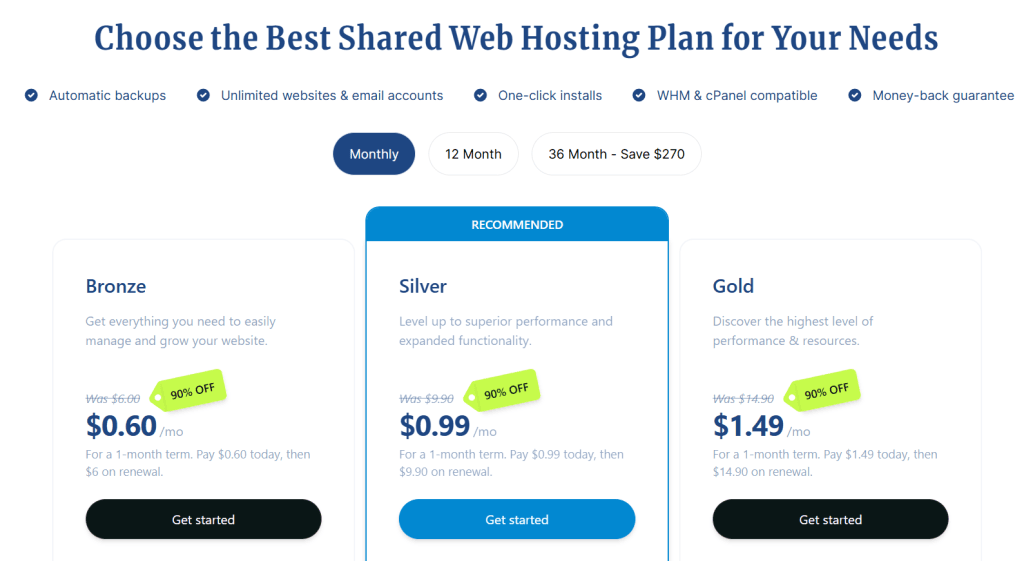
What immediately stands out is how openly Verpex presents its resource allocations right on the pricing page. The Bronze plan (1 website, 30GB NVMe SSD) includes 1GB of RAM and 1 vCPU.
Silver (100 websites, 50GB NVMe SSD) bumps that to 2GB of RAM and 2 vCPUs. Gold (unlimited websites, 100GB NVMe SSD) matches Silver’s compute resources but doubles the storage.
Every plan includes unlimited email accounts, unlimited databases, and daily backups; no tier-gating on the basics.
The difference in storage technology matters on “paper”, too. Verpex uses NVMe SSD across all plans, which is meaningfully faster than standard SSD for raw read and write operations. In theory, that should translate into faster database queries and quicker admin load times.
In our own testing, though, that spec advantage didn’t fully show up in real-world response times. Our account monitoring showed a server that was likely overcrowded and consistently sitting in swap, and that had a bigger effect on actual speed than the storage type did.
We break this down fully in the performance section below.
Renewal pricing on Verpex is straightforward: Bronze at $6/month, Silver at $10/month, Gold at $15/month. These aren’t the cheapest sticker prices in the industry, but they’re honest. What you pay at renewal isn’t dramatically different from what you’d expect.
Free SSL: A Real Differentiator
Verpex includes free Let’s Encrypt SSL certificates on all plans, installed at the server level and renewed automatically. You don’t think about it; it just works. Namecheap takes a different approach; it bundles up to 50 PositiveSSL certificates (its own product) free for the first year, installable via cPanel’s SSL AutoInstall tool.
After that first year, you’re looking at a paid renewal, around $12/year per certificate at the basic tier.
For a site owner running one website, that’s manageable. For someone managing 10, 20, or 30 domains on a Stellar Plus plan, that adds up quickly and creates an unnecessary renewal headache.
Namecheap also doesn’t offer a way to install a free Let’s Encrypt certificate at the server level, which may surprise you if you are used to it being standard on most shared hosting plans.
However, this doesn’t mean you have to pay for SSL long-term. If you use Cloudflare as your CDN, you can generate a Cloudflare Origin Certificate and install it manually inside cPanel.
When combined with Cloudflare’s Full (Strict) SSL mode, this setup keeps traffic encrypted from the visitor to Cloudflare and from Cloudflare to your Namecheap server.
It works reliably and avoids paying for SSL renewal. The trade-off is that it requires manual configuration and isn’t as seamless as native server-level Let’s Encrypt support.
Features Side-by-Side
| Feature | Namecheap | Verpex |
|---|---|---|
| Storage | SSD (NVMe on Business/EU/SG) | NVMe SSD on all plans |
| Free SSL | PositiveSSL (1 yr), then paid | Let’s Encrypt, free forever |
| Email Accounts | 30 (Stellar), unlimited on Plus/Business | Unlimited on all plans |
| Free Domain | Annual plan (1 yr) | Annual plan (1 yr) |
| Free Migration | Yes | Yes |
| Redis | No | Yes |
| WP Toolkit | No | Yes |
| CDN | Clearly listed on the pricing page | Third-party integration |
| AI Website Builder | Sitejet | Sitejet |
| LiteSpeed Server | Yes | Yes |
| RAM/vCPU disclosed | Requires research | Clearly listed on pricing page |
| Money-back | 30 days | 30 days |
Performance & Speed
Uptime: Both Deliver on Their Promise
Let’s start with the most fundamental hosting question: will your site stay online?
Honestly, I’ve hosted WordPress sites with Namecheap since 2015 and with Verpex since 2022, and downtime hasn’t been an issue with either host. Both have kept their promise of a 99.99% uptime guarantee.

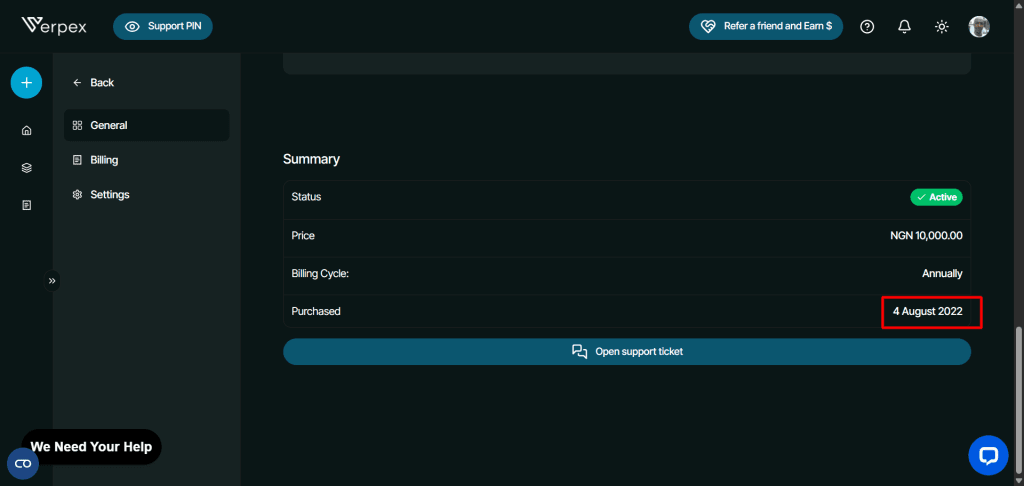
Namecheap advertises 100% uptime on its Stellar plans, backed by a service credit policy, while Verpex guarantees 99.99% uptime on its Silver and Gold plans and 99.50% on its Bronze plan. In practice, both hosts have delivered on those promises in real-world use.
Many hosting comparison articles manufacture downtime drama to make one host look worse than it is. If the sites stayed online, they stayed online, and that’s the honest experience here with both providers.
Where the performance story becomes more interesting, and more differentiated, is in speed, not availability.
Server Technology: Same Foundation, Different Execution
Both Namecheap and Verpex run on LiteSpeed Web Server, which is a genuinely strong foundation. LiteSpeed outperforms Apache and Nginx in most shared hosting scenarios, particularly for WordPress, thanks to its built-in caching layer and efficient handling of concurrent requests.
So, on pure server software, neither host has an edge over the other. The storage layer is where they differ on paper.
Verpex runs NVMe SSD across every plan in its lineup, while Namecheap uses standard SSD on its Stellar and Stellar Plus plans, with faster storage available on Stellar Business and its EU and Singapore datacenter options.
NVMe isn’t a marketing term; it delivers faster read and write speeds than conventional SSDs under equal conditions. But that’s the theory, and it’s a reasonable one.
In practice, storage speed is only part of the equation.
An NVMe drive doesn’t help much if the hosting account on top of it is fighting for memory and disk headroom against its neighbors, and that’s exactly what we found when we checked under the hood on our Verpex account.
Namecheap’s standard SSD setup, without the swap or disk-crowding issues we saw on Verpex, delivered steadier real-world responsiveness in our testing.
Speed and Load Times: The Honest Answer
Here’s something most Verpex vs Namecheap comparison articles won’t admit: raw page load speed is heavily dependent on how well a site is optimized, caching configuration, image compression, plugin load, theme efficiency, and whether a CDN is properly configured in the stack.
Two WordPress sites on the same server can have wildly different load times purely based on how they’re built and configured. Attributing speed differences entirely to the host, without controlling for those variables, produces misleading conclusions.
What the host does control meaningfully is Time to First Byte (TTFB), the time between a browser making a request and receiving the first byte of a response from the server. This is a direct measure of server responsiveness, and it’s what we address next.
Real-World TTFB Test: Namecheap vs Verpex
We ran a live TTFB test on both sites using a server response-time testing tool like SpeedVitals across 40 global locations. Then, we went further and checked what was actually happening on the server side, not just the number on the screen.
Namecheap site, US data center, served via Cloudflare CDN:
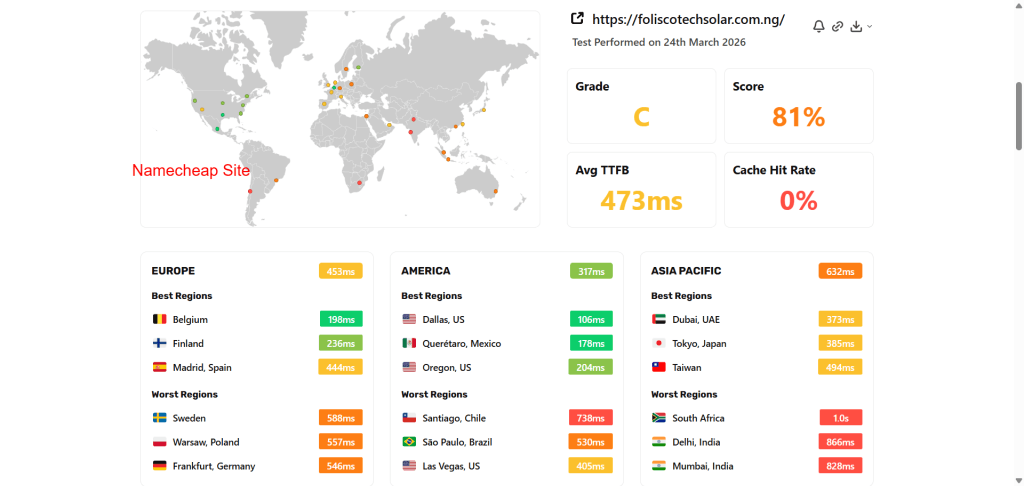
Overall Grade: C | Score: 81% | Average TTFB: 473ms | Cache Hit Rate: 0%
Best performers: Dallas, US (106ms), Belgium (198ms), Finland (236ms)
Worst performers: South Africa (1.0s), Delhi (866ms), Mumbai (828ms)
A 0% cache hit rate here means the test hit the origin server directly, bypassing Cloudflare’s edge cache entirely. That’s the raw, unoptimized server response, not what a visitor experiences once Cloudflare is actually configured to do its job.
And that’s the real finding: Namecheap’s origin server itself responds without the kind of resource contention that shows up on Verpex. Server monitoring on our account showed swap usage consistently under 5% and disk usage under 25%, comfortably healthy.
But 473ms uncached is still slower than what’s achievable, and the fix is straightforward. Pair the account with Cloudflare, set proper cache rules for static assets and full-page caching where appropriate, and turn on Cloudflare’s Smart Tiered Cache.
Tiered Cache routes cache misses through a single upper-tier data center instead of every edge node hitting your origin independently, which meaningfully cuts both the frequency and cost of origin round-trips.
Namecheap’s raw server speed isn’t dramatic, but it’s dependable, and once tiered caching is layered on top, global response times improve substantially.
Verpex site, Singapore datacenter, served via Quic.Cloud CDN:
An earlier test we published showed a 73ms average TTFB with a 100% cache hit rate, and on the surface that number looked hard to beat.
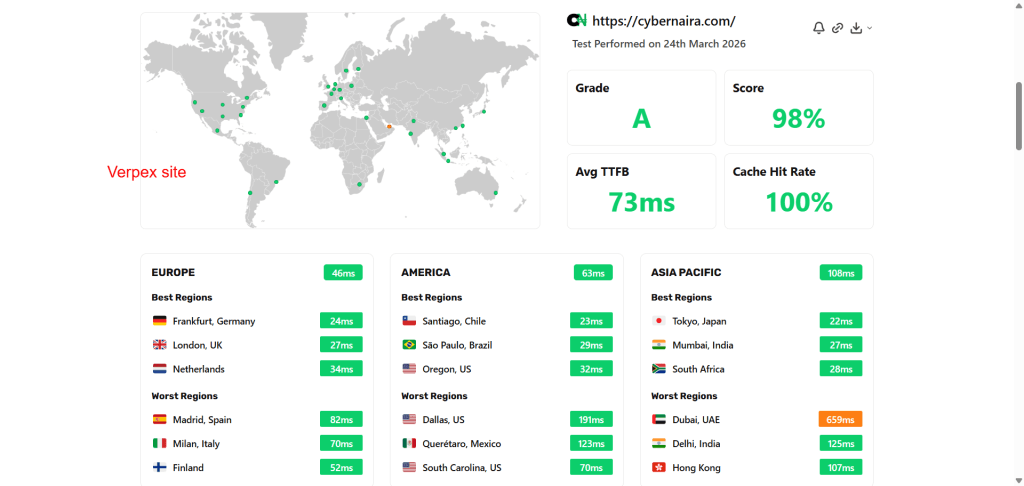
But a 100% cache hit rate means every single test request was served from Quic.Cloud’s edge, never once reaching the origin server. It measured the CDN, not the host.
When we went back and checked what the Verpex origin server was actually doing, past the cached number, the picture changed substantially. Server monitoring showed swap usage sitting between 80% and 94%, peaking at 98% and disk utilization consistently above 85%. Those aren’t cosmetic numbers.
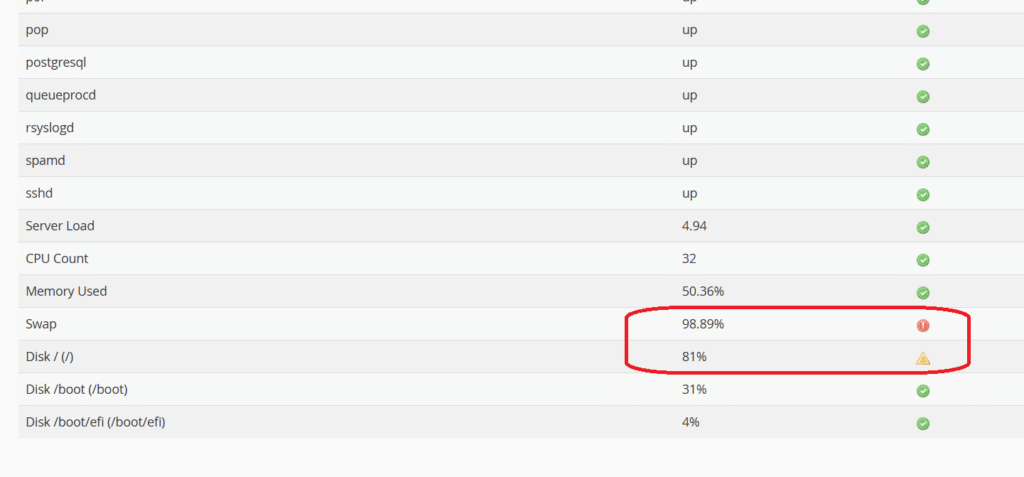
A server leaning that heavily on swap is under real memory pressure, and disk usage at that level typically points to a crowded shared environment.
In practice, this showed up as origin response times roughly in the 900ms to 2,000ms range on direct, uncached hits. A very different story from the 73ms the cached test reported, and slower than Namecheap’s uncached origin response.
So What Does This Actually Tell Us?
A few things worth being direct about.
First, a cached CDN number is not a hosting benchmark; it’s a CDN benchmark. Whether it’s Namecheap behind Cloudflare or Verpex behind Quic.Cloud, the moment the cache is fully warmed, you’re measuring the edge network, not the server underneath it.
Any comparison that treats a 100% cache hit rate as proof of server speed is measuring the wrong thing.
Second, once you look past the cache and at the origin server itself, Namecheap held up better in this test. Its uncached TTFB (473ms) was measurably faster than Verpex’s uncached origin performance, and it did so without the swap and disk pressure we found on the Verpex account.
Third, this matters beyond a single number. Swap and disk overcrowding tend to correlate with shared-resource strain. They can quietly affect more than raw speed, including how consistently a crawler can fetch and re-fetch your pages over time.
None of this erases Verpex’s real advantages elsewhere. NVMe storage as a spec, Redis availability, WP Toolkit, and a wider spread of global datacenters are genuine and unrelated to this specific finding.
But on the core question this section is meant to answer, real server responsiveness, Namecheap’s origin performance was the more dependable one in our testing. It becomes genuinely fast once it’s paired with proper Cloudflare cache rules and Smart Tiered Cache turned on.
With nine data center locations, including Singapore, India, Australia, London, Central Europe, Canada, and Mexico City, Verpex can still place your origin server physically closer to your primary audience from the start. This is a structural option Namecheap doesn’t fully match (EU access on Namecheap requires a two-year plan commitment).
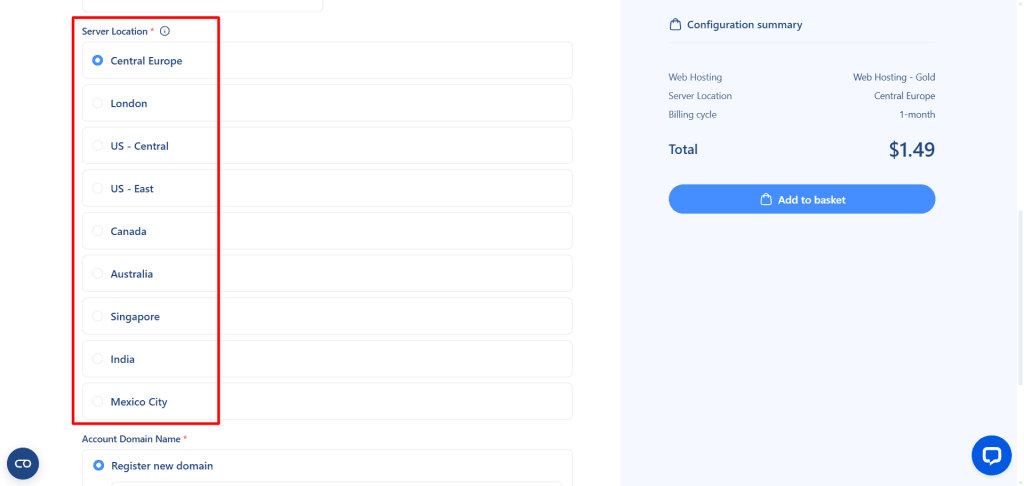
That proximity advantage is real, but our testing suggests it doesn’t outweigh the effect of a server that’s already under resource pressure.
Ease of Use & Setup
Getting Started: Namecheap Wins on First Impressions
For a first-time user, the onboarding experience matters more than most hosting companies acknowledge. Setup confusion kills confidence early, and a rocky start colors how you feel about a host for months afterward.
Namecheap has a clear edge here. From the moment your payment goes through, the path to a live site is remarkably straightforward. This is especially true if you also register your domain with Namecheap, which is common since most Namecheap users start with domain registration.
DNS configuration requires updating it in your domain registrar account; cPanel is accessible within minutes of signup, and WordPress installs via Softaculous in under two minutes. There’s very little friction between paying and having a working site.
Verpex’s experience is smooth in almost every respect, except for one genuinely puzzling step.
During my sign-up, Verpex required manual payment verification by submitting proof of payment before the account could be activated, even though the system had already processed the payment and sent a receipt to my email.
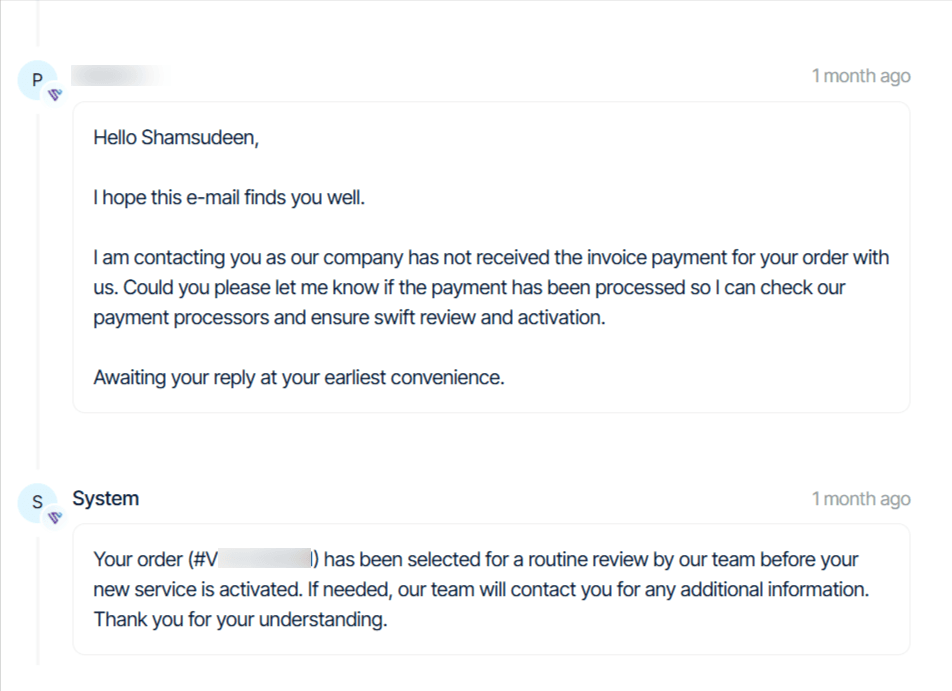
It’s worth noting that this may not reflect how Verpex operates for every customer. It could simply be a one-time verification step triggered by my specific account, location, or payment method.
Nevertheless, it’s not a dealbreaker, but it’s a friction point that is worth knowing about before you sign up. Once you clear that hurdle, everything else about Verpex’s onboarding is well executed.
cPanel: Familiar Interface, Different Toolsets
Both web hosts use cPanel, so the core experience- managing files, databases, email accounts, DNS records, and one-click installs- is familiar territory for anyone who has used shared hosting before.
The learning curve for newcomers is the same on both platforms.
They diverge in what’s layered on top of cPanel, and that’s where the day-to-day experience of managing a WordPress site starts to feel noticeably different.
Namecheap provides WordPress management through WordPress Manager by Softaculous. Softaculous is a capable and widely used tool that handles installations, updates, backups, and cloning. It gets the job done, and most users will find it perfectly adequate.
Verpex gives you both WordPress Manager by Softaculous and WP Toolkit, and the way you manage WordPress through the two tools differs significantly.
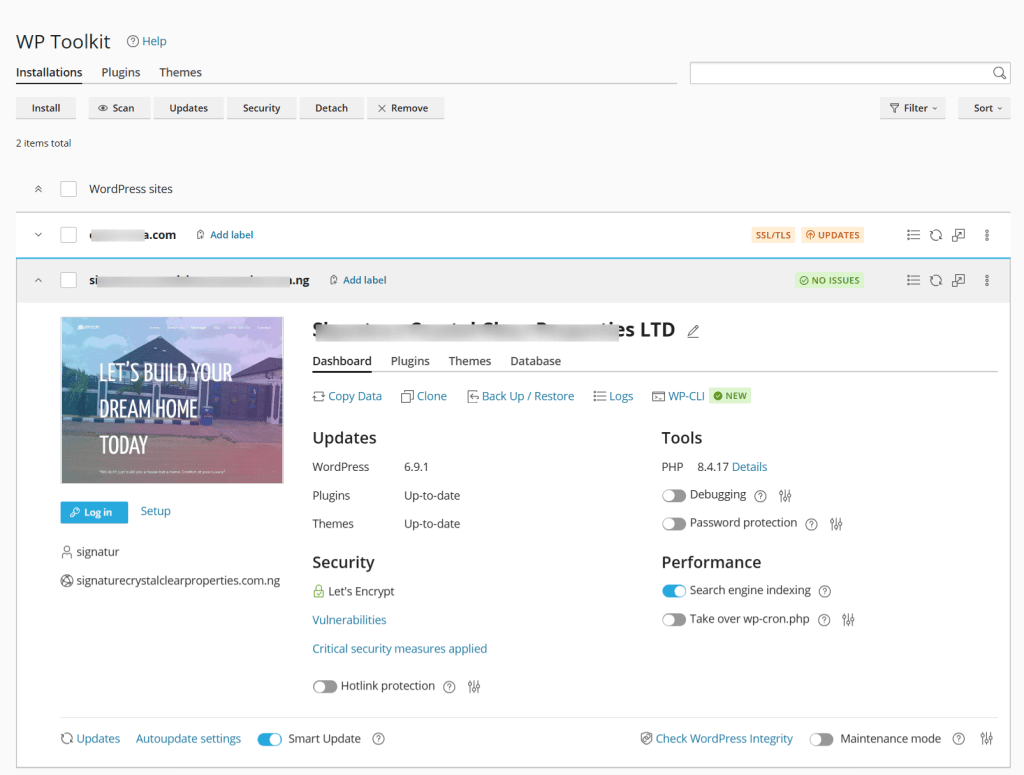
WP Toolkit is a more sophisticated interface that lets you manage installations, selectively apply updates, clone sites, create staging environments, run security scans, and manage plugins and themes, all from a single, well-designed dashboard without ever leaving cPanel.
Having both tools available means Verpex caters to casual users comfortable with Softaculous and to developers or power users who want the deeper control WP Toolkit provides.
Namecheap’s absence of WP Toolkit isn’t critical for someone running a single personal blog. But for anyone managing multiple WordPress installations, an agency, a developer, or a site owner who runs several projects, it’s a real workflow difference.
Softaculous Premium Plugins
One feature both hosts share, and that often flies under the radar, is access to premium plugins bundled through Softaculous.
These include tools such as SpeedyCache Pro, SiteSEO Pro, Loginizer Pro, PageLayer Pro, GoSMTP Pro, SocialFeeds Pro, and more, all installable directly from the WordPress management interface.
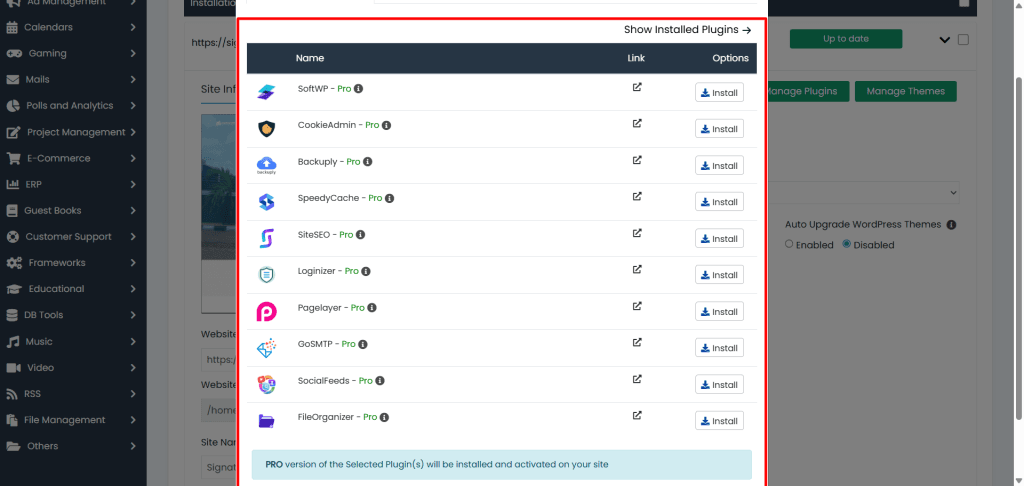
These aren’t stripped-down trial versions; they’re fully functional Pro licenses available for free for a defined period, some up to a year. For a new site owner, this alone can save a meaningful amount on plugin costs in the first year. Both Namecheap and Verpex offer this through their Softaculous integrations, so neither has an advantage here.
Redis and Caching
Inside cPanel, one of the most consequential differences between the two hosts is the presence, or absence, of Redis.
On Verpex, Redis is available as an object cache directly from within your hosting account. Enabling persistent in-memory caching can reduce database load and resource pressure on dynamic WordPress sites.
Combined with LiteSpeed Cache, it gives WordPress a two-layer caching stack, at least in principle.
On Namecheap shared hosting, Redis isn’t available. Namecheap offers it on VPS and dedicated server plans, but shared hosting users have no access, regardless of which Stellar plan you’re on.
For a standard WordPress blog or brochure site, this won’t be noticeable. For WooCommerce stores, sites with logged-in users, or any installation generating a high volume of dynamic database queries, the absence of Redis Object Cache is a real gap on paper, though its practical value depends on the account underneath it having the headroom to use it well.
Migration: Equally Good on Both
If you’re moving an existing site to either Namecheap or Verpex, the free migration service delivers on its promise.
Communication speed and turnaround were comparable across both, and in both cases, the migration was handled cleanly without data loss or configuration issues.
This is one area where neither host has a meaningful edge; both handle it well, and neither charges extra for it.
Security
On security, Namecheap and Verpex share a broadly similar foundation, which is reassuring because it means neither host leaves you exposed at the infrastructure level.
Verpex and Namecheap run on CloudLinux with CageFS isolation, which means each hosting account is sandboxed from other accounts on the same server. A compromised site on a neighboring account cannot affect yours.
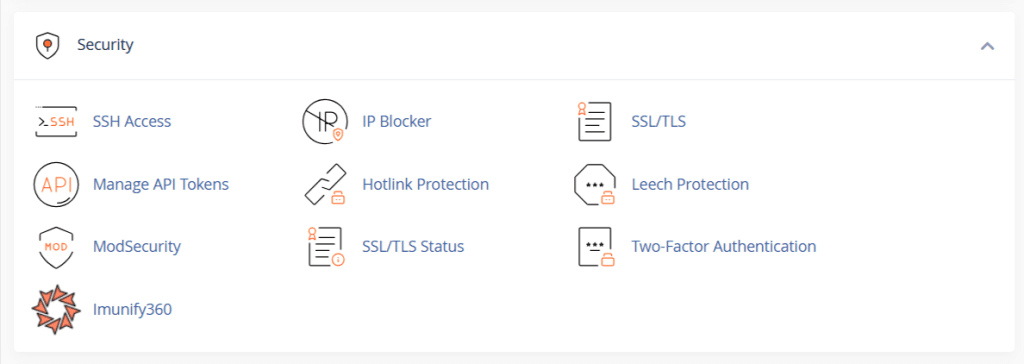
Both include ModSecurity, a web application firewall that filters malicious HTTP requests before they reach your site. They provide Two-Factor Authentication for cPanel access, IP blocking, Hotlink Protection, Leech Protection, and SSH access.
Both allow you to select your PHP version directly from cPanel, an important capability for WordPress compatibility and security patching.
Imunify360, the industry-leading real-time malware scanner and intrusion detection system, is available on both platforms and directly visible in the cPanel security panel.
It runs continuously in the background, scanning files for known malware signatures, blocking suspicious traffic patterns, and alerting you to threats without requiring any manual configuration.
Beyond these built-in tools, security is largely up to the user. The host provides the tools; the site owner decides whether and how to deploy them.
Support and Overall User Experience
When something breaks, or you simply need clarification, support quality matters more than feature lists. Both Verpex and Namecheap offer 24/7 support, but the experience can feel slightly different depending on what you need help with.
I have engaged with their customer support on many occasions. Honestly, both Verpex and Namecheap offer excellent customer support. They’re responsive, dedicated, and efficient in solving WordPress-related issues.
One thing worth noting is that Verpex offers multiple channels: live chat, email tickets, and phone support.
Namecheap offers live chat and email tickets only. Although I don’t need to call, you may want to confirm whether phone support is a priority for you.
There is no clear winner for availability or response time. Both web hosts are accessible at any time. They also offer meaningful support that goes out of their way to resolve your issues.
Who Is Each Host Best For?
Choosing between Namecheap and Verpex isn’t simply about one being better than the other. It comes down to what you’re building, how technical you are, and what you’re optimizing for.
Here’s how to think about it.
Best for Total Beginners: Namecheap
If you’re launching your first website and you want the path from payment to live site to be as frictionless as possible, Namecheap is the more sensible starting point. The entry hosting price is lower, which reduces the financial risk of a first hosting purchase.
More importantly, if you register your domain with Namecheap, which is a natural first step given that domain registration is what most people know Namecheap for, DNS configuration is essentially easier to manage.
There’s no digging through nameserver settings or waiting for propagation across unfamiliar panels. Everything lives in one place.
The onboarding experience reinforces this. From payment to cPanel to a working WordPress installation, it’s a smooth, well-signposted journey that doesn’t assume prior hosting knowledge.
Best for WordPress Performance: Namecheap, Once Cloudflare Is Configured Properly
This is the section where our position differs most from what you’ll find elsewhere.
On paper, our Verpex stack: Quic.Cloud CDN, LiteSpeed Cache, and Redis reads like the stronger performance setup, and Redis genuinely is a real advantage Namecheap shared hosting doesn’t offer.
But as pointed out earlier, our Verpex account showed real strain in swap usage and disk utilization, translating into origin TTFB roughly between 900ms and 2,000ms.
By comparison, Namecheap’s origin is more consistent and stable. Namecheap isn’t going to win a raw speed contest against a well-resourced VPS, but it’s a steady, honest number from a server that isn’t fighting for headroom.
Namecheap needs help where most shared hosting does: at the edge. Pair the account with Cloudflare, set cache rules for static assets and cacheable page types, and turn on Smart Tiered Cache so cache misses route through a single upper-tier location instead of hammering the origin from every edge node.
Once that’s in place, global response times improve substantially, and the origin isn’t already stretched thin.
If your priority is a genuinely fast, dependable site and you’re willing to spend a few minutes configuring Cloudflare properly, Namecheap is the host we’d point you toward based on what we found in testing.
Redis is still a real point in Verpex’s favor for database-heavy sites, and we cover that directly in the section below.
Best for WooCommerce, Membership, and eCommerce: It Depends on What’s Straining Your Site
eCommerce sites are inherently database-heavy. Every product page, cart update, session, and checkout generates queries that add up under real traffic, and this is one area where the two hosts genuinely diverge, for different reasons than you’ll read elsewhere.
Redis remains exclusive to Verpex on shared hosting, and for a WooCommerce store with heavy logged-in traffic, Redis Object Cache absorbing repeated database queries in memory is a real, meaningful feature.
That part of the case for Verpex still holds up. Namecheap shared hosting doesn’t offer this at any Stellar tier.
But the resource pressure we found on our Verpex account – high swap usage and disk I/O- matters here too, arguably more here than anywhere else.
A busy WooCommerce store needs headroom, not just the right caching tools sitting on top of a server that’s already under strain. If the underlying account is fighting for memory, Redis has less room to do its job well.
The honest takeaway: if Redis is the deciding factor and your Verpex account has enough headroom, which will vary account to account and plan tier, it remains a genuine advantage on paper.
If your bigger concern is dependable server responsiveness under load, Namecheap paired with Cloudflare’s caching layer, including Smart Tiered Cache, deserves serious consideration too, particularly since our testing found its origin server handling requests more steadily than Verpex’s did.
Best for Agencies and Developers: Verpex
For agencies managing multiple client sites or developers who want fine-grained control over their WordPress installations, Verpex is the stronger platform on tooling grounds.
WP Toolkit alone justifies this. Managing, updating, cloning, auditing, and hardening multiple WordPress installations from a single cPanel interface is a genuine workflow improvement over relying solely on Softaculous WordPress Manager.
Add SSH access, Git support, Redis, staging environment capability, and transparent resource allocation per plan. Verpex is clearly built with technical users in mind, even accounting for the server headroom concerns we found in testing.
Namecheap is not without developer-friendly features; SSH, Git, and Softaculous are all present, but the absence of WP Toolkit and Redis on shared hosting means agencies doing serious WordPress work will bump into limitations that Verpex doesn’t impose.
Best for Users Who Want Global Audience Reach: Verpex
If your audience is spread across multiple regions, or concentrated in a market outside the US and UK, Verpex’s nine data center locations give you a genuine advantage in server placement that Namecheap cannot match at the same plan level.
Being able to host your site in India, Australia, Mexico City, or Central Europe without upgrading to a two-year plan is a flexibility that can translate into better TTFB for your target audience. This is assuming the account itself has enough resources to make that proximity count.
For Namecheap, EU datacenter access requires a two-year commitment, a real restriction if you’re not ready to lock in that long.
Best for Budget-Conscious Site Owners: Namecheap
If your primary constraint is cost and you’re running a straightforward site, such as a blog, portfolio, or small-business landing page, Namecheap’s entry-level pricing is hard to argue with.
The Stellar plan gets you online for less per month than any comparable Verpex plan, and based on our testing, you’re not giving up real-world server responsiveness to get there.
The tradeoff is the SSL renewal cost after year one, the 30-account email cap on the base plan, and a less capable WordPress management toolset. But for a site owner watching every dollar, that tradeoff is easy to live with.
Pros & Cons
Namecheap Pros
Namecheap Cons
Verpex Pros
Verpex Cons
FAQs
Conclusion
Verpex and Namecheap both deliver capable shared hosting, but our head-to-head testing shifted our own view on where each one actually stands.
Once you strip away CDN caching on both hosts, Namecheap was more consistent in our testing than Verpex. There was no swap pressure, no disk crowding, just a steady, if unremarkable, response time that becomes genuinely fast if you add a CDN to it.
Combined with its lower entry pricing, simpler onboarding, and SuperSonic CDN on annual plans, Namecheap is the host we’d point most WordPress site owners toward for dependable real-world performance in 2026.
Verpex still has genuine strengths that have nothing to do with this finding: NVMe SSD storage, Redis Object Cache on shared hosting, WP Toolkit, unlimited email on every plan, and a wider spread of global data centers.
The right decision still depends on how you plan to use your hosting, but the performance data now points more clearly toward Namecheap than before.