
If you use Rank Math on your WordPress site, you already know it’s one of the most powerful WordPress SEO plugins available.
Even the free version includes features competitors’ plugins lock behind a paywall. But as your site grows, questions come up fast.
That’s what this guide will help you figure out.
Instead of just listing prices, I’ll walk you through what actually changes at each level.
We’ll look at keyword tracking limits, Content AI credits, client website allowances, analytics depth, and the features that make one plan more suitable than another.
You’ll see how each upgrade benefits a specific type of user — whether you’re a solo blogger, an affiliate marketer, a freelancer managing client sites, or running a growing SEO agency.
Let’s start with the full pricing structure so you can see how everything is positioned before we break down each plan in detail.
Rank Math Pricing Overview (Free, Pro, Business & Agency)
Before I break down features one by one, let’s look at how Rank Math structures its pricing.
Rank Math offers four main tiers:

NOTE:
The price in the above image is the monthly quote; you will be billed annually. Your first-year subscription includes a promotional discount. The discount depends on the plan.
There’s also a separate bundle called the SEO + Speed plan ($143.88 first year), which we’ll cover later.
All paid plans are billed annually. You pay upfront for one year, and your license renews each year unless you cancel.
The higher you go, the more websites you can use it on, the more keywords you can track, and the more Content AI credits you receive.
Now here’s the key thing most people miss: the difference between Rank Math plans isn’t just about “more features.” It’s mainly about scale.
The core SEO features stay powerful across all versions. What changes is:
If you’re running one personal blog, you don’t need the same setup as someone managing 80 client websites. That’s why Rank Math separates Pro, Business, and Agency the way it does.
At a high level, the Free plan gives you foundational SEO tools. The Pro plan unlocks professional-level rank tracking and advanced features for unlimited “personal websites”.
The Business plan is built for freelancers and small agencies managing client sites. The Agency plan is for high-volume SEO operations handling hundreds of websites and large keyword datasets.
This structure makes it easier to see where you fit before diving into each plan.
Now, let’s start with the Free plan so you can clearly see what you’re getting before spending a dollar.
Rank Math Free Plan – What You Get (And Where It Stops)
The free version of Rank Math is a major reason the plugin became so popular in the WordPress ecosystem.
As of writing this post, Rank Math has over 3 million active installations. That’s no small achievement for a non-default WordPress plugin.
Many free SEO plugins, such as Yoast, give you the basics and lock anything advanced behind a paywall. Rank Math’s free plan goes further than you’d expect.
NOTE:
Check out our Rank Math vs Yoast SEO comparison if you’re still considering which SEO plugin to pick for your site.
With the free version, you get:
That’s already enough for many beginners to properly optimize blog posts, product pages, and landing pages.
You can connect your site to Google Search Console, see keyword impressions, rankings, and monitor basic performance data directly inside your WordPress dashboard.
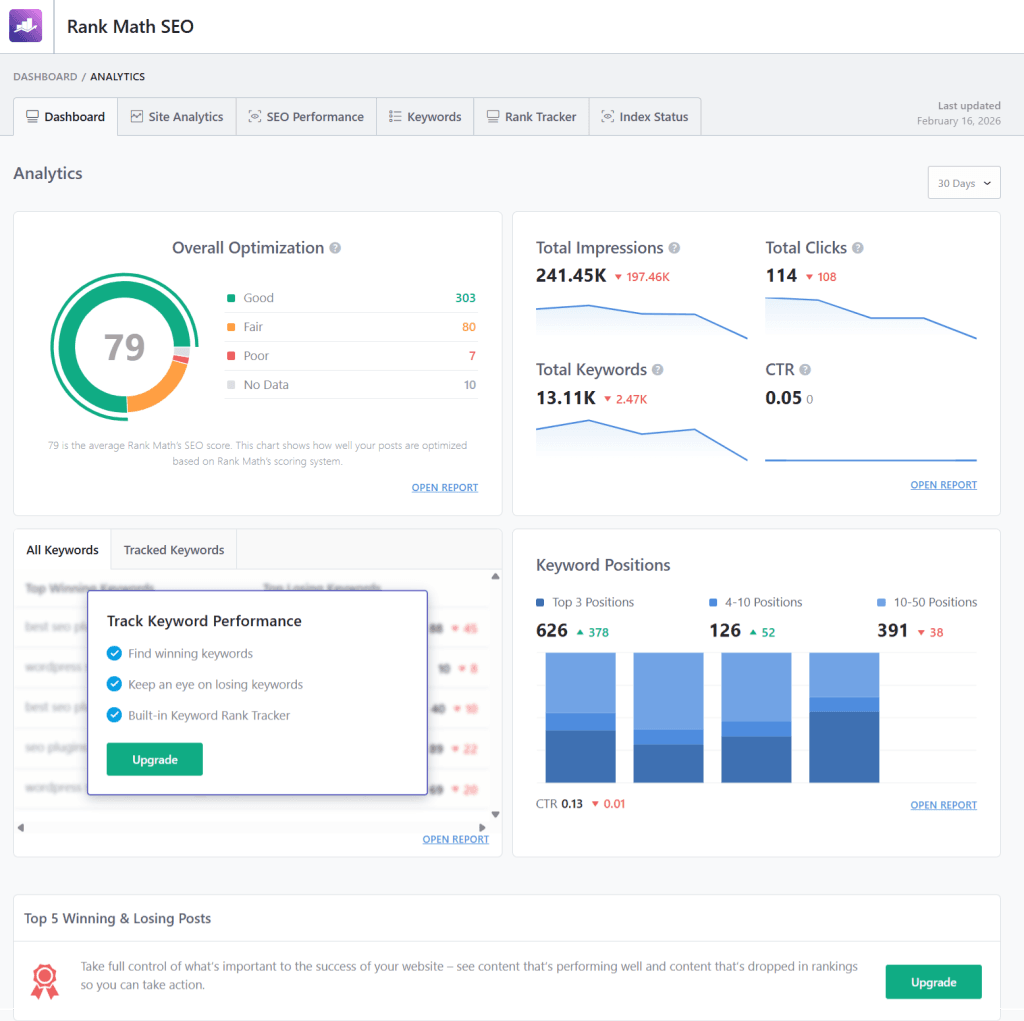
For a brand-new blog or a small niche site, this is more than enough to get started.
So why would anyone upgrade to Rank Math SEO Pro?
Here’s where the Free plan begins to limit you.
First, keyword rank tracking is restricted. You don’t get advanced position tracking with daily updates for many keywords.
If you care about monitoring ranking changes closely, especially for affiliate or client work, you’ll quickly feel this limitation.
Second, Content AI access is minimal. If you want built-in content optimization suggestions powered by AI, you’ll need a paid plan with more credits.
Third, usage is meant for personal, non-client projects. If you manage websites for clients, the free version isn’t designed for that scale.
The Free plan is excellent for beginners, hobby bloggers, and small site owners who want a strong SEO foundation without paying. You can download the free version of the Rank Math SEO plugin and use it for as long as you’re ready to upgrade.
However, once your site traffic starts growing, you generate revenue, rankings matter more, or you start managing multiple sites, you’ll need deeper tracking and scalability.
That’s where Rank Math Pro starts to make sense.
Rank Math Pro Plan ($95.88 ): What You Unlock and Why It Matters
When you go to Google or any other search engine and search for “Rank Math Pro pricing,” this is the plan you are probably considering.
The Pro plan is where Rank Math shifts from a powerful free WordPress SEO tool to a serious growth engine for bloggers, affiliate marketers, and small business websites built on WordPress.
The biggest upgrade from free to Pro is the ability to scale and track.
With Pro, you can use the plugin on unlimited personal websites. That alone makes it attractive if you run multiple niche sites, test projects, or manage a portfolio of blogs under your own ownership.
You’re no longer restricted to a single site or basic usage. But the real difference shows up in keyword tracking.
Pro allows you to track up to 500 keywords with advanced rank tracking. That means you can monitor keyword positions daily, track performance changes over time, and identify ranking drops before they become serious traffic losses.
If you depend on organic traffic for affiliate revenue or lead generation, this is a major advantage.
Instead of guessing whether your SEO efforts are working, you see measurable movement.
Another key feature in Pro is enhanced access to Content AI, with up to 5k monthly credits. Content AI helps you optimize posts using data-driven suggestions based on target keywords.
It analyzes competing pages and recommends word count, headings, related terms, and questions to include.
For businesses focused on ranking competitive keywords, this tool alone can justify the upgrade.
Pro also expands schema capabilities. While the free version supports 18 predefined schema markups, Pro gives you more flexibility and automation.
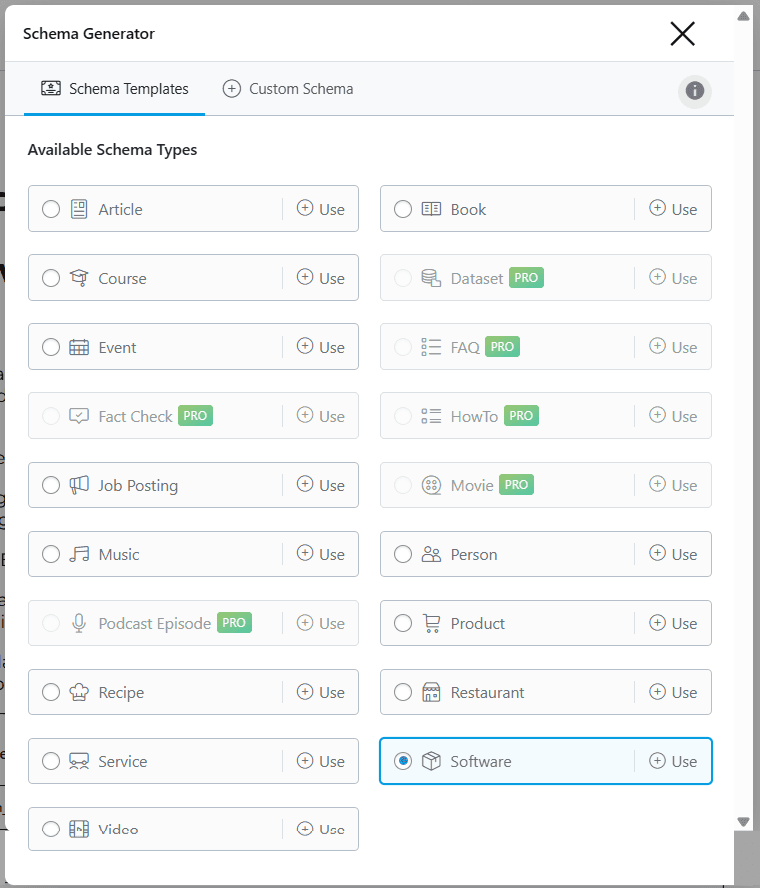
It supports 24 predefined schema markups, including speakable schema, and you can import schema markup from any website in one click.
If you publish reviews, recipes, products, or news content, advanced schema improves your chances of earning rich results in Google.
That can mean higher click-through rates without changing your rankings.
You also get advanced analytics pulled directly from Google data. Instead of switching between tools, you can view ranking data, keyword trends, and performance reports inside your WordPress dashboard.
This simplifies workflow and saves time.
So, who is Rank Math Pro really for?
It’s ideal if you:
If you’re still building your first site and don’t track many keywords yet, the Free plan may be enough to hold you over. But once rankings start driving revenue, Pro becomes less of an expense and more of an investment in visibility and control.
Rank Math Business Plan ($299.88) Built for Freelancers and Growing Agencies
Once you move beyond managing your own websites and start handling SEO for clients, the Pro plan feels insufficient.
That’s where Rank Math’s Business plan becomes a viable solution.
The biggest shift here isn’t just more features; it’s permission to scale commercially.
With the Business plan, you can use Rank Math on up to 100 client websites. That’s a major difference from Pro, which is meant for personal sites only.
If you’re a freelancer offering SEO services or running a small digital agency, this alone justifies the upgrade. You’re now operating within a license designed for client work.
Keyword tracking jumps significantly as well. Instead of 500 tracked keywords in Pro, Business allows you to track up to 10,000 keywords.
That changes how you manage SEO campaigns. You’re no longer choosing only your top terms to monitor. You can track entire keyword clusters, long-tail variations, and campaign-level performance across multiple client projects.
For agencies reporting progress to clients, this level of tracking becomes critical. You can monitor trends, see ranking improvements over time, and adjust strategies before traffic declines.
The Business plan also increases Content AI credits to 12k monthly credits. If your workflow includes optimizing client articles with AI-driven recommendations, more credits let you scale content production without constantly buying add-ons.
This is especially useful for agencies offering SEO content services alongside technical optimization.
Another benefit is enhanced reporting, white-label email reports, and deeper analytics. When you manage multiple client sites, you need organized data and the ability to send branded SEO reports.
The Business tier makes it easier to oversee performance across a larger portfolio without jumping between tools.
So, who should choose the Business plan?
It makes sense if you manage SEO for clients, run freelance SEO services, or operate a small-to-mid-sized agency. It is also ideal for large-scale keyword tracking and for agencies or freelancers who regularly create optimized content for multiple websites.
If you’re only running your own blog, the Business subscription is overkill. But if SEO is part of how you make money professionally, the jump from Pro to Business isn’t just about bigger limits; it’s about operating legally and efficiently at a client level.
Rank Math Agency Plan ($659.88/yr) Maximum Scale for High-Volume SEO
The Agency plan is Rank Math SEO’s highest-tier offering, designed for teams operating at serious scale.
If the Business plan supports growing freelancers and small agencies, the Agency plan is designed for established SEO companies managing large client portfolios.
The first major difference is the number of websites allowed.
With Agency, you can install the Rank Math SEO plugin on up to 500 client websites. That’s a huge jump from the Business plan’s 100-site limit.
For agencies handling dozens or even hundreds of ongoing SEO retainers, this removes licensing bottlenecks. You don’t have to worry about hitting usage caps as your client base expands.
Keyword tracking capacity also increases dramatically. The Agency plan allows tracking up to 50,000 keywords.
This matters if your agency runs full-scale SEO campaigns across multiple industries, locations, and keyword clusters. Instead of monitoring only primary keywords, you can track thousands of long-tail terms, category keywords, product variations, and location-based phrases.
For agencies providing detailed monthly SEO reports, this level of tracking gives you stronger data to present to clients.
You can show growth trends, spot ranking volatility early, and back strategic decisions with clear performance metrics.
Content AI credits are also at their highest in this plan. You get 30k AI credits per month, a huge jump from 12k in the Business plan.
If your team produces optimized content regularly — blog posts, landing pages, product descriptions — having more credits built into your subscription helps reduce the cost of separate AI tools.
It keeps your SEO workflow centralized inside WordPress.
Another key benefit is priority support. When you manage hundreds of sites, downtime or technical issues can affect multiple clients at once.
Faster support response becomes more than a convenience; it protects your business operations.
So, who should consider the Agency plan?
This plan makes sense if you:
If you’re a solo blogger or even a small freelancer, the Agency plan is unnecessary. But for companies where SEO services are a core revenue stream, the increased limits and support level make it practical.
Key Differences Between Pro, Business, and Agency
Now that you’ve seen each plan on its own, let’s clearly separate what actually changes as you move from Pro to Business to Agency.
At first glance, the features look similar. All paid plans of Rank Math include:
The real difference comes down to four things: usage rights, scale, data limits, and support level.
The Pro plan is designed for unlimited personal websites. That means you can use it on all the sites you personally own.
However, it’s not meant for client work.
Keyword tracking is capped at 500 keywords. That’s more than enough for one or several niche sites, but it becomes restrictive when managing multiple campaigns.
The biggest change when you upgrade to Business is commercial usage. You can install Rank Math on up to 100 client websites.
That shifts the plugin from a personal SEO tool to a professional service tool.
Keyword tracking jumps to 10,000 keywords, letting you monitor full campaigns across multiple domains and traffic sources, including AI search performance.
Content AI credits also increase, supporting client content workflows.
Moving to the Agency plan further expands those limits. You can manage up to 500 client websites and track up to 50,000 keywords.
This isn’t about new core features; it’s about handling scale without restrictions. If your agency grows quickly, you won’t outgrow the license.
Support priority also improves, which matters when dozens or hundreds of client sites depend on a stable SEO infrastructure.
Think of it this way: the higher plans don’t change how SEO works. They remove the ceilings that limit growth.
Rank Math Content AI Credits – How They Work and Why They Matter
One feature that often drives people to upgrade from Free or Pro is Rank Math’s Content AI. It’s an AI-powered tool like SurferSEO that helps you optimize your content for better rankings, but understanding how Content AI credits work is crucial.
Content AI doesn’t just rewrite your posts or generate text automatically. Instead, it analyzes the top-ranking pages for your target keyword and provides actionable SEO recommendations.
It tells you things like how many headings to use, which related keywords to include, the internal/external link count, the optimal content length, how to fix image alt text and titles, NLP terms, and common questions people are searching for.
Essentially, it gives you a data-backed blueprint for writing content that’s more likely to rank.
And the good part? It scores your content on a scale of 1-100 as you write. This helps you see whether your content is well optimized or needs more work.
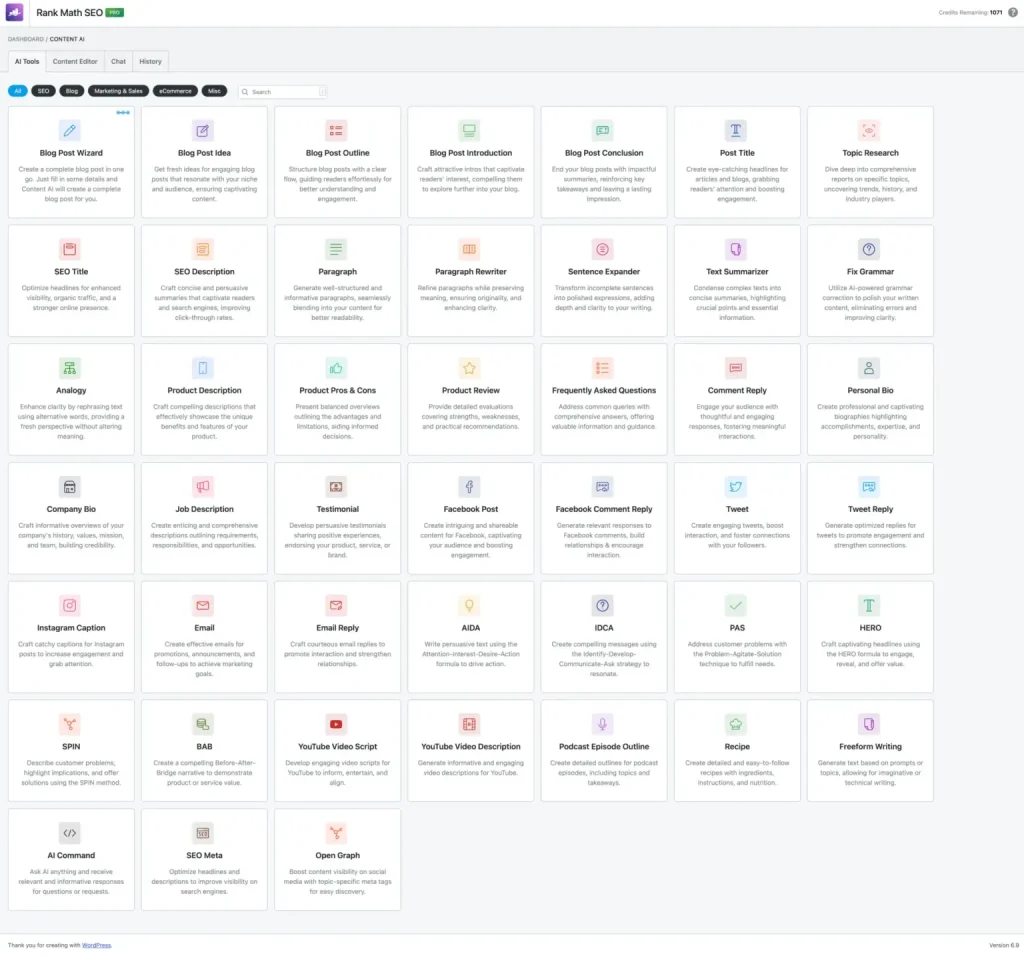
Another solid feature of Content AI is the Content Generation Templates. With this latest feature, you can quickly generate tailored content based on your specific use case.
For example, with one click, it generates a meta description, product description, tweet, Instagram caption, email copy, Open Graph, company bio, etc.
The number of Content AI credits you get depends on your plan:
Each time you analyze a page with Content AI, chat with Rankbot, or generate image alt text, it consumes credits. The more pages or keywords you analyze, the faster your credits are used.
500 credits are consumed for every Content AI research request, 50 credits for generating an alt for images, 1 credit for every word generated through Content AI, and 1 credit per word when you chat with Rankbot.
That’s why larger agencies or content teams benefit from the Business or Agency plan. You won’t run out of credits in the middle of a campaign.
However, you can purchase a Content AI credit plan separately if you need more credits than what’s included in your RankMath paid plan.
Content AI turns Rank Math from a standard SEO plugin into a proactive optimization assistant, and the credit allocation reflects the scale of your site or business.
It’s one of the key differentiators that make upgrading from Free to Pro or from Pro to Business worth it if content production and optimization are core to your strategy.
Rank Math SEO + Speed Plan – SEO Meets Performance
Ranking well in Google is no longer about high-quality content, keywords, and schema; site speed matters too. That’s where the SEO + Speed plan from Rank Math makes sense.
It bundles Rank Math SEO Pro with a WP Rocket single-site license, giving you both SEO optimization and performance enhancements in one package.
WP Rocket is a leading caching and performance plugin for WordPress. It handles tasks such as page caching, lazy-loading images, optimizing CSS and JavaScript, and improving Core Web Vitals, all of which are essential for faster page loads and a better user experience.
Google increasingly factors site speed and user experience into rankings, so having WP Rocket integrated can complement Rank Math’s SEO features.
The SEO + Speed bundle gives you:
This bundle is especially valuable if your site relies heavily on traffic and user experience for revenue. For example, affiliate sites, eCommerce stores, SaaS websites, marketing agencies, and content-heavy blogs.
Instead of purchasing Rank Math Pro and WP Rocket separately, the bundle saves you money and ensures both tools work seamlessly together.
The bundle package costs $143.88, with a 14% discount on the first-year subscription. So instead of paying $154.88 for both plugins separately, you pay $143.88 for both plugins.
However, if you need to use WP Rocket on more websites, you can upgrade the license within your dashboard.
FAQ About Rank Math Pricing
When choosing a Rank Math plan, you may have a few common questions. Here’s what you need to know.
Can I upgrade later if I start on Free or Pro?
Yes. You can upgrade at any time. Your existing site configuration stays intact, and you’ll gain access to higher limits, Content AI credits, and additional features immediately after upgrading.
Can I downgrade if I no longer need the higher plan?
You can downgrade by letting the current license expire or canceling it midway. After that, you can resubscribe to your preferred plan. If you’re a new customer, you may need to submit a refund request to initiate the downgrade process. Note that advanced features tied to your plan, such as advanced keyword tracking or additional client sites, may stop working after the downgrade. Plan around your usage needs to avoid disruption.
Do I need RankMath Pro for schema markup?
No. The Free plan supports basic schema types, which are enough for standard posts and pages. However, Pro and higher plans offer advanced schema templates, automation, import, and support for specialized content types like HowTo, movie, podcast, dataset, and news. These can increase visibility in rich results.
Is the SEO + Speed bundle worth it?
If you care about page speed as well as SEO, yes. Fast-loading pages improve user experience and Core Web Vitals, which can influence search rankings. Combining Rank Math Pro with WP Rocket in one plan simplifies management and ensures both tools work smoothly together.
Conclsuion
Choosing a Rank Math SEO plan is about matching your SEO toolkit to your workflow and goals. Each upgrade isn’t just extra features; it’s about efficiency, insight, and scalability.
The Free version gives you solid foundations, while Pro adds the tools to track and optimize your content more strategically. Business and Agency plans focus on managing multiple sites and campaigns, giving you the capacity to take on larger projects and clients.
The SEO + Speed bundle is a smart choice if performance matters alongside optimization, letting your pages load faster while still ranking effectively.
Think of your plan as an investment in control and growth. Choose what fits your current needs, but keep an eye on what you might need as traffic, content volume, or client demands grow.
That way, you’re not paying for unused tools, but you’re ready to scale when the time comes.